Search This Blog


Monday, 26 July 2010

Is There Life After La Rochelle? What Next?

Mal du Pays, Part II may have sounded like the end of the blog but it's not! We have decided we might be addicted to blogging! So we plan to continue to let you know about our new adventures in England and Paris as we count down to September 9 and our return to Toronto. As well, we imagine that we may have some interesting experiences upon our return.  Perhaps a bit of culture shock? Soon we will be relaxing at a cottage in England. We hope to take some of that time to begin to think about what this year has meant to us, individually and as a couple. What  has changed in our perceptions of the world and of ourselves? What are we taking back to Toronto and how might we want our life to change there as a result of living in La Rochelle?
We will try and keep to our schedule of every Monday so tune in . . .

Mal du Pays Part 2

We have left La Rochelle. We still have seven weeks left in Europe, but on Friday it was goodbye to the place that has been home for the past ten months. While we have made a home in La Rochelle, it is not Home. During the past ten months I have thought alot about the meaning of Home. I wonder what David and I mean when we say we are 'going home'.  Is it Canada? Toronto? Hutton Avenue? Or is it really friends and family?  Interestingly, there is no real word for Home in French. The closest translation is chez nous which to me does not capture the emotion and personal history of the English word. We have talked about this with our French friends and they agree. They say that generally when they say chez nous, they are talking more about the physical aspects of home, sometimes about what happens in the home, but not the warmth and belonging that seems to be inherent in the English word.
Thornton Wilder said: "When you're safe at home you wish you were having an adventure; when you're having an adventure you wish you were safe at home." Leaving La Rochelle has been a  double-edged sword. We were both really sad to give up all that was there for us. But when we thought of being back in Toronto, we felt a real urgency to be there soon, to reconnect with family and friends and to feel at home. It seems that now I am going to have mal de pays in two directions! There are so many things I am going to miss about La Rochelle and now that Home is getting closer, I can allow myself to begin to miss all the things I love about Home in Toronto. This conflict of emotions certainly made us aware of the need to 'be in the moment' so as not to miss all the experiences of our last days in La Rochelle.
I will miss the beauty of La Rochelle. Even after ten months, I continued to rubberneck when walking about the town. The last few days I took longer to look, to try to remember my favourite sights: the statue of one Bonne Femme right on our street,  the rooftops from our balcony in the early morning light, the old clock tower with the wonderful boulangerie nestled in its shadow (with the best pains au raisins in the city!), the nooks and crannies that are part of any walk in this city.


I will definitely miss the great luxury of having a splendid market within steps of my front door and especially the wonder of the food in it. I will miss the people we know around the city: the shopkeepers, market stall vendors, the wonderful hairdresser, the helpful woman in the mercerie. I have been a real customer for them, someone they took time to know. Just before leaving I went to say goodbye to many of them and was truly touched by their good wishes to us. Even Blondie told us she will miss us, 'les gens sympas sur le balcon' ! And, of course, we will miss our friends. How amazing to be leaving these relationships carved out in only ten months, in a country where we were told this would be impossible. We feel sure that they will continue via email and Skype, becoming richer and stronger. We will be saying goodbye to the wonderful apartment where we have lived so comfortably as well as the gym (and handsome Ludovic), the park, the cafés and all the other things that are part of our daily routine. I am going to miss being me in French and the feeling of victory and competence that comes with that. And I will miss the idea of myself as an adventurer, someone willing to give up Home for exciting experiences.
But . . . Home beckons and I am ready to be there. I crave Canadian Old Cheddar, cranberry sauce, a battery operated phone, maple sugar, our bed with a box spring instead of slats, a final canoe trip in the glorious Canadian autumn, that quiet, Canadian way of saying 'sorry'. Most of all,  I crave all of you. I knew you were important to me before I left but this time away has served to let me know just how important. I am looking forward to gathering friends and family together to hear first hand about your adventures and accomplishments but most of all to let you know how much you have been missed.  Like the "Burd" in Stuart McLean's story, "Just like anyone else who has ever had a home, she had followed that universal urge to leave. Of all the mysteries of migration maybe that's the only true thing, the one true thing, that we know and share with animals big and small, this sense of seeking, finding and leaving but above all, of returning home."
A très bientôt. See you soon.

Monday, 19 July 2010

Au Revoir Poitou Charente

There are some interesting differences between English and French. Why is there no word like home in French? And how is it that au revoir seems more meaningful than goodbye? These words are much on our mind as we enter our last week in La Rochelle. Goodbye is a shortened version of God be with you; more like Adieu. Au revoir literally means until we meet again. It expresses that emotion that many of us feel when forced into goodbyes, that it isn't forever, that we will find this place, these people again. Perhaps it is also because au revoir is surrounded by the physicality of handshakes and bisous that it seems more emotional and meaningful than goodbye. In any case, we have certainly embarked on lots of goodbyes. So we decided to say a small goodbye to our region, Poitou Charente by renting a car and doing a last small bit of exploration.
We set out early one morning and headed to the far eastern border. To get there, we passed the birthplace of Mme. de Montespan, the most influential of Louis XIV's mistresses and la Ferme Acadienne (the Acadian Farm), a memorial to the Acadiens who returned to this area, havng been expelled from Nova Scotia in 1774. We skirted Poitiers, the old capital (and scene of our French Visa interview) and moved from flat, seaside geography to rolling hills and rich farmland. After about 200 km, we were in Angle-sur-L'Anglelin, one of the prettiest villages in France.With its ruined castle high above the winding streets and squares of the upper and lower villages, it was indeed very pretty. We wandered around, had a delicious lunch and 
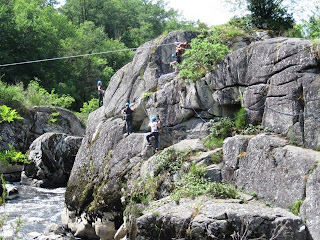
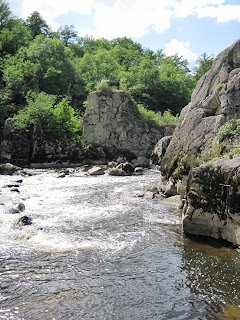
set off again for a geological site: Les Portes d'Enfer (the Gates of Hell). We wanted to see where the soft, white calcite rock of our area turns to the granite of central France. We enjoyed a hike through the forest at the edge of the Gartempe River, clambering over real granite again, remembering hikes in Ontario. At the Portes d'Enfer, we found a camp group of teenagers, rock climbing the precipice over the white water. I watched with admiration as a group of early adolescent girls made their way along the steep rock. On our way down, I said to one that I had admired her courage, perhaps I would have refused to do it myself. "Ah, non," she said matter of factly, "they make us do it. We have to." And like teenaged girls everywhere, her friends clustered around her as I walked on: "What did she say? What did she say?"
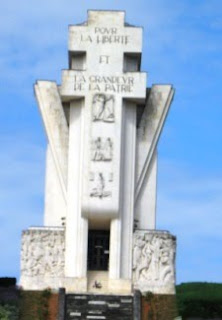
We spent the night in Confolens on an uncomfortable but beautiful bed and woke up to have a rvietting breakfast conversation with our hostess, an English woman who had lived there for over 10 years and an English couple who wanted to live there. After breakfast, I predicted some difficulties for them! Their knowledge of French was so minimal that she pronounced les as less; they had no knowledge of French politics or social life and their relationship seemed quite frail: she treated him like a child and he rolled his eyes at her remarks. Later our hostess told me she and her family were thinking of leaving Confolens as there were now so many British it just wasn't the same. On our evening stroll, we passed a British pub serving bangers and mash, a store called the Best of British and in the B and B found three different expat magazines just for the area!!!! It seems there are now over 100,000 British living in France. We wondered how many of them are integrated into the local French life and what impact their presence is having on local culture. Heading out that morning we discovered by chance, the memorial to the Resistance dead.

And then we were off to the grand and historic Château de Larochefoucauld, owned and lived in by the same family for centuries; home of the 17th century writer of maxims and potential home to a new project by the famous Chinese architect, M. Pei, who designed the Pyramid at the Louvre.


The donjon collapsed quite recently. In keeping with the family tradition of adding a new style of architecture every few hundred years, M. Pei was asked to reconstruct it. The plan is for a glass addition. It will house a virtual library and part of the chateau will become a school of architecture. Sadly, the townsfolk are not pleased and want the donjon restored to its ancient style. The LaRochefoucauld family is extensive and has had its hand in French history for 
centuries. 


François IV wrote his Maximes in  this delightful small room. Much later, his descendant, Edmée, worked very hard to bring French women the vote in 1944. Later, driving through very rich agricultural land full of vines, we were more struck by the beauty of the fields and fields of sunflowers than the vines. They stretched sometimes for a kilometre, holding their yellow faces to the east.


And then we were off to our own château for the night--Le Château de la Tillade, owned and operated by the Vicomte and Vicomtesse de Talbert. We found charming hosts, interesting conversation and history over a glass of Pineau from their farm when we arrived. Upstairs a very comfortable bedroom waited.


Off to dinner in the local town, Pons, once a thriving centre on the pilgrims route to Santiago. Because of this, a large centre was built that is now a museum. I suspect that our meal at the Hotel de Bordeaux was a cut above those of the pilgrims: baked mullet, M. Guilbeau's pigeon, warm homemade bread, wine of the region, chocolate/caramel cake and crème brulée. We are always amazed to find such wonderful restaurants in the country, serving fine food, cooked with care and creativity. How we will miss this at home in Ontario!
Our lunch the following day in the historic town of Santes was equally good and atmospheric as we sat by the river overlooking the ancient Roman Arch.
And then it was back to La Rochelle, our last drive up the Autoroute at 130 km/hr. For the first time, our drive through the old centre to Rue des Bonnes Femmes was faultless. We have finally learned the tortured one way system for cars! And we were chez nous, back in lovely # 6. Were we home? More about the difference between those two words next week. Meanwhile, we are in the throes of packing and saying more goodbyes!


Monday, 12 July 2010

Potpourri from La Rochelle

The Soldes are here again! Every La Rochelle store window is covered in ads; some creative and others junky. And once again, they all began on the same date, regulated by Paris, June 30th. The streets were filled that first week with people staggering under the weight of their various boxes and bags. I have bought a few things but even at 50% offf, the various items I had admired in the expensive shops are way too much for me--beautiful jackets on sale for €250? I think not!

All sorts of festivals follow each other, one after the other. The Night of Music (when outdoor spaces, gardens, street corners and cafés were filled with musicians), The Documentary Film Festival, the 38th International Film Festival, the Francofolies (an international celebration of French music and performers) have all overlapped. In fact there are so many festivals we are told, there is no space for a big celebration of the Fête Nationale, July 14!! Just some fireworks which we will pretend are in honour of David whose birthday it is. The cafés, especially those on the port, are hopping. As well, the streets are thronged with tourists, easily recognizable either by their cameras or their clothes! We take secret delight when they ask us for directions.

Now that the warm weather is here, we are spending time again on our balcony watching the street theatre below. On this very short street, there are two restaurants, two very expensive women's clothing stores (see €250 sale jackets above), a wonderful hat store and of course, the Sex Book Shop. 

We have drawn a sociogram of the merchants and watch to see it played out. One restaurant Le Boute en Train (Live Wire) has an outdoor terrace and seems to be much more successful than O5, right next door. O5 has a lovely garden behind the restaurant but they do very little to sell its delights. In fact, they are very bad at selling themselves at all. So Le Boute  is usually full and O5 is often empty.

The chef/owner of O5 has been seen several times flogging a prospectus with well-heeled businessmen. Unsuccessfully, we imagine, as he seems a very grumpy man. None of the other merchants talk with him. He has even given David an angry harangue about garbage. The woman who runs the shop next door is also grumpy about garbage and has spoken severely to David when he dared to put it out before 7:30 PM when the stores close. David's radar about women's clothing has been sensitized since coming to France and he has christened her Peasant Woman. He wonders how she can sell expensive and sophisticated clothing dressed the way she is. She is very good friends with the staff of Le Boute and often sits on their terrace, drinking coffee (they are on the sunny side of the street). She has also been seen deep in conversation with Olivier of the Sex Book Shop. The man who runs the hat shop is a great reader and keeps to himself although seems to be friendly with everyone. The owner of the even more expensive women's shop on the corner never smiles and speaks to no one. Olivier is friends with everyone!

Then there are our neighbours who live above the stores. Blondie continues to intrigue us. She carries on waving across the street to us as she closes her shutters. We rarely see her go out. One family member suggested that perhaps she works in the phone sex world?! The Short-Haired Woman's hair is now growing longer and longer. She had a succession of boyfriends over the winter but now one seems to have settled in. The Sax Player has improved immeasureably. He now plays real tunes without mistakes. The Commune continues to come and go and are having yet another baby and far across the rooftops, Les Gars with the dodgy deck that disappeared in the tempête, are gone. The deck is gone too, replaced by a new roof and there is a For Rent sign on the window. We will say goodbye to them all when we leave, although some of them won't know it. I am sure we will wonder from time to time in Toronto, what has become of them all.

Patientez, s'il vous plaîit!

The post is coming soon! We had a big party here this weekend to celebrate David's birthday and to say goodbye to friends. I need a little more time to finish the post.

Monday, 5 July 2010

Adieu, M. Grue

Our season of goodbyes has begun. This past week we had our final French lesson with Sylvie, who has urged us on in our studies with skill, warmth and a sense of humour. We will miss her and certainly hope a trip to Canada will be in her plans.


And now, Monsieur Grue is gone! After all the months of watching him build the apartments, read Sartre (or play games on his phone!) and climb up and down the ladder, he and his crane have left the skyscape. David has been watching the progress of the buildings and had been predicting this for some time. We knew it wouldn't be long when we saw him swinging dumpsters full of leftover detritus out to the street. Then one morning, I noticed that a new and different crane had been added to the skyscape and then this is what I saw.

This man was joined by a mate and together, agile as mountain goats, they clambered in and out of the crane. From where we watched, it looked like the demolition of a Meccano project. They would unscrew large bolts at the end of one section, clamber back inside the adjacent part of the crane and wait for the new crane to remove the unscrewed part. Then on to the next one. All the while, M. Grue was in his cabin, reading (or playing games on his phone), waiting for instructions to move one part or another of his machine. True to French custom, everything stopped for an hour while they all went for lunch and then the painstaking procedure resumed. The removal of the 'grue' took the whole day so we couldn't restrain ourselves from going to have a closer look. As in all countries, there seemed to be an inordinate number of men standing around watching so we joined them and watched too. It was interesting to see how skillfully all the huge pieces were manoeuvred out over the roof into the narrow street below where a large flatbed truck was waiting.  


The apartments are nearly finished and look very nice. They, like most of the new buildings in the city centre, blend in well with the rest of the neighbourhood and will provide much needed housing in the area. Now our skyscape is curiously empty.


I miss watching M. Grue, admiring the skill of his work. hearing the humming of his crane. Goodbyes, even to crane operators, can be difficult! 

Monday, 28 June 2010

Chance Encounters

When you are able to be in the moment, it is amazing what can open to you. Slowing down, looking around have led us to chance encounters with interesting people. Here are a few recent encounters.
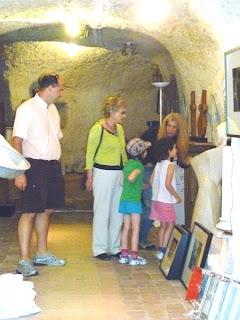
For hundreds of years, French people have been living in caves cut out of the cliff faces of soft tufa limestone or dug underground. Disused since the 50s when social housing became a state priority, caves have made a comeback. Today many of these rough dwellings have been snapped up as idiosyncratic homes. The caves also provide ideal conditions for wine storage and most recently for growing mushrooms. The Loire and Loir valleys are dotted with former cave villages. Of course, the granddaughters were fascinated by the idea of living in a cave so we set out to see Trôo, the troglodyte village on the Loir River.

 Frustrated in our attempt to visit the museum, I noticed a woman emerging from the cave home above it. I called out to her in French, wondering if she knew who the museum staff person might be. Imagine our surprise when a deep, very English voice replied! She told us the museum was definitely closed and, in answer to our question, that she had had her cave since 1991. I longed to ask more but she set off purposefully down the steep path, carrying a dirty casserole dish and a wine carafe. We spent some time speculating about what could have led her to a cave in a small village. I was reminded of the English woman with
the bed and breakfast in Lauzerte, on our way to the Pyrenees. David thought of the woman he and Géry met on the the Ile d'Oleron near La Rochelle, alone in a small house in an isolated spot. Of course, English women have been travelling the world and writing about it for centuries and these women are part of that courageous group.
Then, while visiting the small village of Lavardin, classed as one of the most beautiful in France, our search for a cave led to another chance encounter. Wandering down the road to take 
 photos of the imposing ruined castle at the top of the hill, I saw a sign indicating a sculpture atelier. Barging in, I discovered a woman with long blond hair.  We had come across Aprille Best Glover, a wonderful American sculptress. Aprille was warm and welcoming, spending time with us and our granddaughters, talking a bit about her work, her cave and her life in this small village. She was warm, gracious and funny. For more information about her and her writer husband, see their web sites.
http://aprille.net/
http://cavelife.net/


Here in La Rochelle, we were having a Sunday walk and happened upon a large blue door with a sign indicating a chapel. We were puzzling over this as there didn't seem to be a church nearby when a voice said: "Vous voulez entrer?" We looked around and an older woman was talking to us from the window of her car. We, of course, replied "Oui" so she parked her car and, accompanied by a man, arrived with a ring of very large keys. The blue door opened into a small and exquisite chapel of which they were very proud. It had been built by one of the archbishops of La Rochelle and was now used by a small group for Mass in Latin. The man turned out to be an American, who had lived in La Rochelle since the 60s. He had just donated a small organ to the chapel to accompany the Gregorian chanting of the Mass. Again, I longed to pepper him with questions about how he fetched up in La Rochelle, which in the 60s was really a backwater. His manner didn't invite questions of that sort.
Perhaps it isn't only the notion of slowing down and being in the moment but also having the interest and the courage to approach people and ask questions. I have done this far more frequently here than I ever do at home. Now I am wondering why? What is it about being away that makes me more courageous or even more interested? And would people at home respond so readily to me as they do here, knowing I am a foreigner. More to think about as we begin to plan for our return to Toronto. How will we carry what we have learned this year into our life in Toronto?